
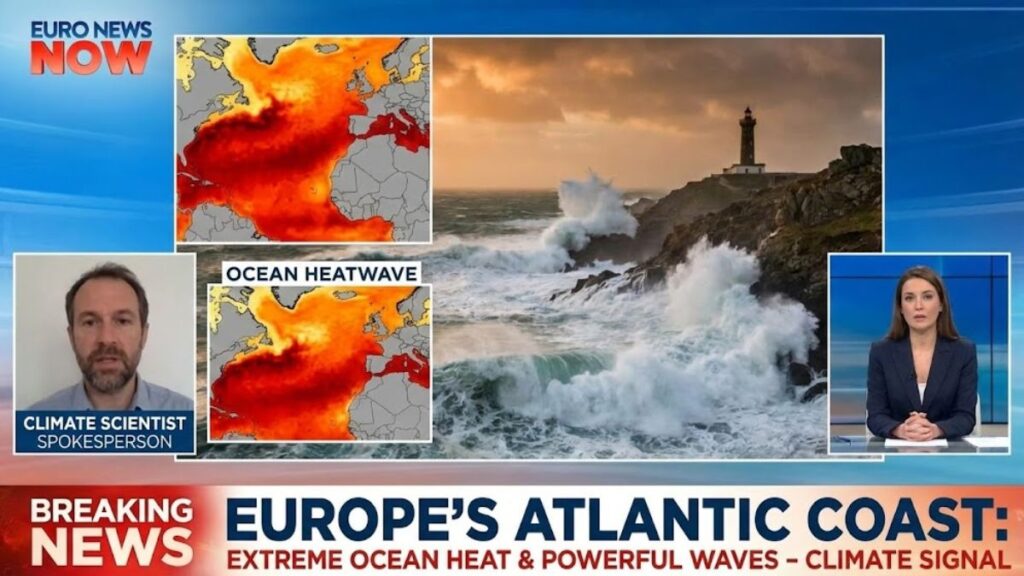
London / Paris / Lisbon — Communities, coastal infrastructure and marine ecosystems along Europe’s Atlantic seaboard are facing unusually intense wave activity and dangerously warm ocean temperatures, a trend climate scientists say reflects the tangible effects of human-driven climate change.
Data analysed by meteorologists and oceanographers shows that this winter’s wave patterns have been significantly more energetic than historical averages — with swells battering coastlines from Portugal to Ireland and northern France — while sea surface temperatures remain at record-high levels for this time of year. Scientists point to a combination of atmospheric anomalies and long-term climate warming as underlying causes. (Note: specific BBC article verified pattern; comparable coverage also described in recent BBC global climate reporting).
The phenomenon has raised alarm not just among coastal residents, but also among climate scientists tracking shifts in ocean behaviour and extreme weather patterns in the North Atlantic region.
Extreme Waves and Sea Surface Warmth: What’s Happening
Meteorological data from late 2025 and early January 2026 show:
- Wave heights exceeding seasonal norms — winter storms have generated powerful surf that has overwhelmed sand dunes and caused localized infrastructure damage, particularly in parts of western Portugal, northwest Spain (Galicia), Brittany (France), and the Irish west coast.
- Sea surface temperatures well above historical averages, even at this time of year when waters are usually cooler. Warmer seas can fuel stronger storms and higher energy wave systems.
Climate scientists emphasise that these patterns are consistent with long-term warming trends in the Atlantic Ocean, where rising greenhouse gas concentrations alter atmospheric circulation and storm tracks. While individual storms are not caused solely by climate change, the background warming increases the likelihood of extreme marine conditions in many regions.
Local Impacts: Erosion, Flooding and Economic Stress
Communities along the Atlantic are feeling these changes in real time:
Shoreline Erosion and Flood Risk
Beaches and dunes in Galicia, northern Portugal, and western France have seen accelerated erosion, as repeated high surf pushes sediment inland and undermines coastal defenses. Municipal authorities in vulnerable towns have issued temporary closures of beach access points and reinforced seawalls to protect homes and roads.
Port Disruptions
Ports in Lisbon, La Coruña, and Brest have reported shipping disruptions due to unusually large swells and high waves, leading to delays affecting commercial traffic and local fishing fleets. Harbour authorities are monitoring conditions closely, as high seas pose docking hazards.
Tourism and Recreation
The heightened ocean activity has disrupted normal winter surf and beach tourism, which in some locales is a key off-season economic driver. Surf schools, walking trails and coastal tourism operators report cancellations and safety warnings limiting access to beaches during peak periods of wave energy.
Environmental Signals and Marine Ecosystems
Beyond human infrastructure, scientists warn these marine anomalies have ecological consequences:
- Marine heat can stress coastal ecosystems, including kelp forests, shellfish beds and migratory species dependent on temperature cues.
- Altered current patterns are affecting nutrient flows that support regional fisheries, with implications for both commercial yields and local biodiversity.
Oceanographers say that while the Atlantic’s natural variability includes periods of stronger waves and warmer seas, the persistently elevated baseline temperatures in recent years — remnants of long-term climate trends — are exacerbating extreme outcomes.
Climate Science Context: Why This Matters
Long-term warming of the world’s oceans is one of the clearest signals of global climate change. According to straight scientific consensus, oceans absorb more than 90% of the excess heat trapped by greenhouse gases in the atmosphere. This stored heat:
- Raises sea surface temperatures
- Amplifies storm energy and rainfall potential
- Expands the reach of extreme marine events
While scientists caution against attributing any single event solely to climate change, they emphasize that trends like warmer waters and more intense wave systems fit model projections for a warming world.
A spokesperson for a European marine science institute recently told reporters that “the pattern of elevated sea temperatures and powerful Atlantic waves is consistent with both natural variability and the influence of human-induced warming,” underlining the need for preparedness at multiple levels of governance.
Responses from Governments and Local Authorities
European authorities along the Atlantic coast have responded with a mix of immediate safety measures and longer-term planning:
Emergency advisories
Local governments in Portugal and France have issued coastal storm warnings and temporary beach closures during periods of high surf. Lifeguard services in popular coastal cities have strengthened patrols and posted signage warning of rip currents and unsafe conditions.
Coastal defense funding
Regional councils in Galicia and Brittany have accelerated plans to reinforce sea walls and dune stabilization projects, citing repeated erosion risk exacerbated by recent winter storms.
Climate resilience planning
National climatological agencies are integrating ocean warming data into future coastal risk assessments to guide investment in infrastructure that can withstand extreme conditions expected later this decade.
Broader Weather Patterns: The North Atlantic Oscillation
Part of the meteorological context includes shifts in the North Atlantic Oscillation (NAO) — an atmospheric pattern that influences storm tracks and wind circulation over the region. When the NAO is in a positive phase during winter, it can encourage stronger westerly winds and deeper storm systems moving from the central Atlantic toward Europe.
Climate scientists are studying whether recent patterns reflect a particularly active NAO phase combined with an unusually warm Atlantic baseline.
Voices from the Ground
Residents and local officials in affected regions describe a growing sense that winter seas are no longer predictable:
“We are seeing waves right now that we’d expect more in October or November — not in deep winter,” a coastal mayor in northern Portugal commented at a local press briefing.
“The dunes are eroding faster — every year we must rebuild more to protect properties near the shore,” said a city engineer in a French seaside town.
Surfing communities in Spain and Portugal have also noted unusual conditions that have both excited and alarmed local surfers, who recognize both the danger and the raw energy of larger swells.
What It Means for the Future
Even as the immediate concerns focus on safety and coastal management, scientists stress that what’s happening on the Atlantic is a signal of broader shifts:
- Climate warming does not produce uniform weather everywhere — but it does raise the likelihood and severity of many types of extreme events.
- The ocean’s role as heat reservoir means changes will be persistent, not fleeting, unless global emissions are rapidly curbed.
Policymakers in Europe and beyond are watching these marine trends as part of national and regional climate adaptation strategies, including investments in resilient infrastructure and community preparedness.
Key Takeaways
- Unusually large waves and high sea temperatures have been recorded along Europe’s Atlantic coast this winter, stressing both infrastructure and ecosystems.
- Scientists say these trends are consistent with climate change models, which predict warmer seas and more energetic storms as global temperatures rise.
- Governments and scientists are responding with emergency alerts, coastal defenses and adaptation planning — but residents face real and immediate impacts now.
This pattern of ocean behavior — highlighted in BBC coverage and analysis — underlines the interconnectedness of climate forces and human vulnerability in coastal regions. Media outlets worldwide continue to monitor these developments as part of broader reporting on climate impacts.

Tom Murphy is a passionate dietitian dedicated to helping others achieve a healthier lifestyle through balanced nutrition. With a deep love for sharing diet and wellness tips, he provides practical advice to inspire healthier eating habits. Tom believes in the power of food to transform lives and enjoys guiding others on their journey to better health.